


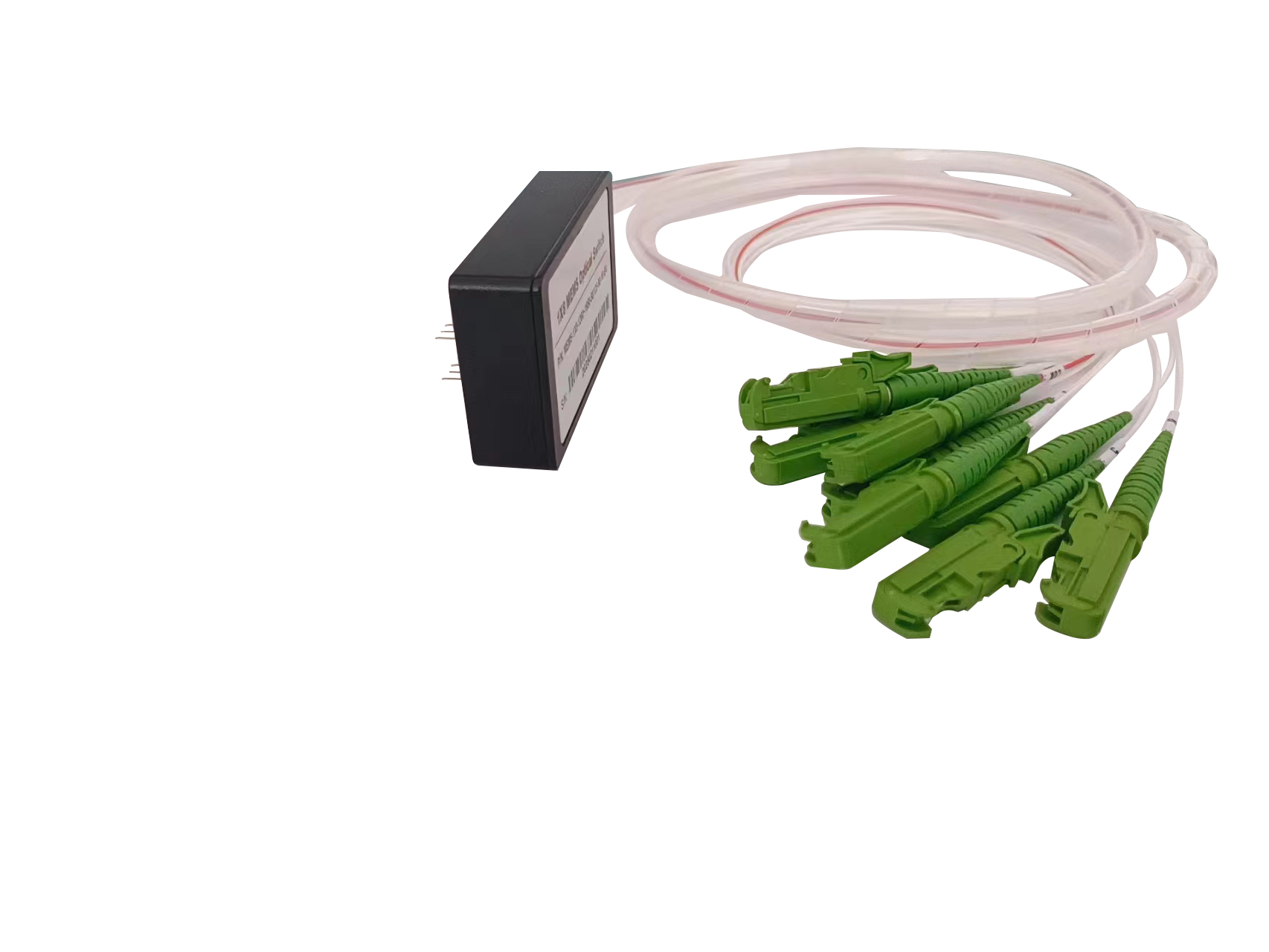
Applications of Low-Power, Miniaturized 1×8 MEMS Optical Switch Modules in Data Centers
With the rapid development of cloud computing, big data, and artificial intelligence, data centers are placing increasingly higher demands on network flexibility, reliability, and energy efficiency. In this context, low-power and miniaturized 1×8 MEMS optical switch modules are becoming key components for optimizing optical networks.
1. What is a 1×8 MEMS Optical Switch Module
1×8 MEMS optical switch module is based on Micro-Electro-Mechanical Systems (MEMS) technology. It uses precisely controlled micro-mirrors to switch one optical input signal among eight output channels. Compared with traditional mechanical optical switches, MEMS optical switches offer advantages such as smaller size, faster switching speed, and longer lifespan, making them especially suitable for high-density optical communication environments.
2. Core Requirements of Data Centers for Optical Switches
Modern data centers typically feature:
- High-density deployment: Large numbers of servers and switching devices
- High bandwidth demand: Continuous growth in data traffic
- High reliability requirements: Minimal service interruption
- Energy efficiency pressure: Increasing operational costs
In such environments, traditional optical link architectures often lack flexibility and are complex to maintain. Optical switches provide a new solution for dynamic network management.
3. Advantages of Low-Power, Miniaturized MEMS Optical Switches
1. Significant Power Savings
MEMS optical switches often adopt latching (bistable) or low-drive current designs. Once switching is completed, no continuous power supply is required, greatly reducing power consumption. This is especially beneficial for large-scale data center deployments.
2. Space Saving
The compact design allows 1×8 modules to be easily integrated into high-density racks or circuit boards, improving space utilization in data centers.
3. High Reliability and Long Lifespan
With no mechanical contact wear, MEMS switches typically offer lifetimes exceeding 1 billion switching cycles, ensuring long-term stable operation.
4. Excellent Optical Performance
- Low insertion loss
- High channel isolation
- Good repeatability and stability
These characteristics ensure minimal signal degradation or crosstalk during switching.
4. Typical Application Scenarios
1. Optical Link Protection
When the primary link fails, the optical switch can quickly switch to a backup path, ensuring service continuity—an essential feature for high-availability data center architectures.
2. Automated Optical Testing
In testing optical modules and fiber links, a 1×8 switch enables automated channel selection, improving efficiency and reducing manual intervention.
3. Optical Line Monitoring (OLM)
Combined with monitoring systems, MEMS switches can periodically or on-demand switch between links to perform multi-point optical power monitoring and fault localization.
4. Flexible Network Scheduling
In Software-Defined Networking (SDN) architectures, optical switches act as physical-layer switching nodes, enabling dynamic bandwidth allocation and path optimization.
5. Technology Development Trends
As data centers evolve toward higher bandwidths (such as 400G/800G) and lower latency, 1×8 MEMS optical switch modules are also advancing:
- Lower power consumption designs for green data centers
- Higher integration levels for on-board applications
- Multiple control interfaces (IIC, TTL, RS232, etc.)
- Intelligent management with remote monitoring and automation
6. Conclusion
Low-power, miniaturized 1×8 MEMS optical switch modules are becoming essential tools for optimizing data center optical networks due to their superior performance and flexibility. Whether in link protection, automated testing, or intelligent network scheduling, they provide significant value. As data centers continue to scale and evolve, MEMS optical switches will play an increasingly important role in future optical networking infrastructure.