


In-Line Fiber Polarizer: Overview, Features, and Applications
I. Overview
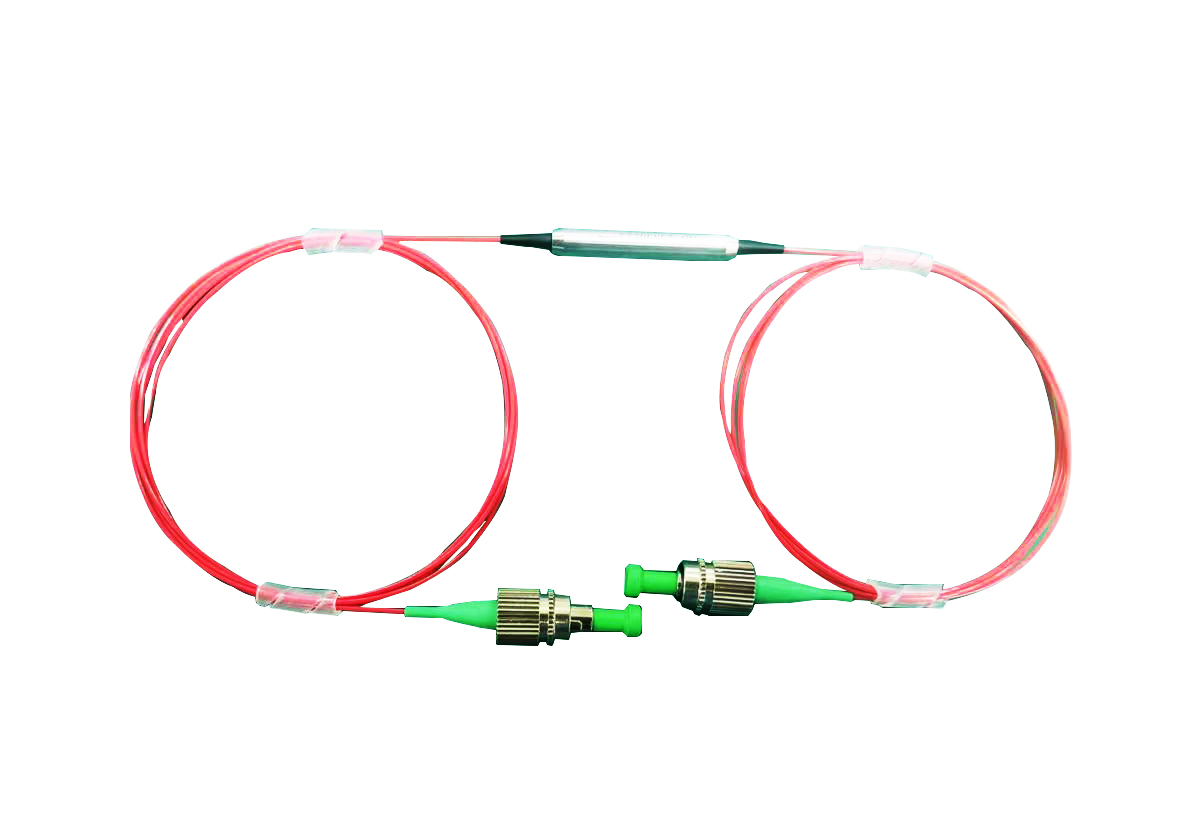
An in-line fiber polarizer is an optical device directly integrated into an optical fiber link. Its core function is to select and output linearly polarized light in a specific direction from input unpolarized or partially polarized light, while suppressing or eliminating other polarization components. It is typically directly fused or integrated into the fiber optic system to achieve “online” polarization control without needing to extend the optical path into free space for processing.
In fiber optic communication, sensing, and laser systems, the polarization state of light is a critical parameter. The performance of many devices (such as modulators, interferometers, and amplifiers) is sensitive to the polarization state of the input light. In-line fiber polarizers ensure the performance stability of these downstream devices and the reliability of the system by providing a stable, single linearly polarized light output.
II. Key Features
* High Polarization Extinction Ratio (PER)
This is a core indicator of polarizer performance, defined as the ratio (usually expressed in dB) of the optical power in the desired polarization direction to the residual optical power in the orthogonal polarization direction after passing through the polarizer. High-performance fiber optic in-line polarizers typically have a PER (Performance Ratio) of over 20 dB, with premium products reaching 30 dB or even higher.
* Low Insertion Loss (IL): This refers to the power attenuation caused by the polarizer to the light signal in the desired polarization direction. Modern fiber optic in-line polarizers achieve very low insertion loss (typically <0.5 dB), even below 0.2 dB, effectively reducing the pressure on the system power budget.
* All-Fiber Structure, High Stability and Reliability: Compared to spatial optical polarizers, fiber optic in-line polarizers employ an all-fiber design, allowing for easy integration into the system via fusion splicing.
This avoids the alignment challenges of spatial optical paths, offering advantages such as strong resistance to environmental interference (e.g., vibration, temperature fluctuations), compact structure, and ease of integration, making them ideal for use in harsh environments or systems operating for extended periods.
* Wide Operating Bandwidth: Depending on the design principles and materials, a wide wavelength range can be covered, from visible light to infrared (e.g., 1310 nm, 1550 nm communication windows, and even above 2 μm).
High Power Handling Capability: Employing suitable materials and structures (such as birefringent crystals or metal films), it can withstand high optical power, making it suitable for high-power fiber laser systems.
III. Working Principle and Common Types
Fiber optic in-line polarizers are primarily based on the principle of generating asymmetric losses between two orthogonal polarization modes. Common technical approaches include:
* **Metal Cladding Type:** Introducing a thin metal film (such as gold or aluminum) near the fiber core. Due to the polarization-dependent absorption of light by metals (surface plasmon effect), one polarization state is strongly absorbed, while the other polarization state passes through.
* **Birefringent Crystal Type:** Coupling a specially designed birefringent crystal (such as lithium vanadate LiNbO₃ or calcite) to the fiber. Utilizing the birefringence of the crystal, the two polarization states are spatially separated, and then spatial filtering outputs only one of them.
* **Photonic Crystal Fiber/Microstructure Fiber Type:** By designing a special air-hole structure, the fiber itself generates an extremely high loss difference between the two polarization modes.
* **Fiber Bragg Grating (FBG) Based Polarization:** This type utilizes the different reflections or losses of specific types of fiber gratings (such as tilted FBGs) to achieve polarization.
Among them, the metal-clad type is currently the most widely used commercial fiber optic in-line polarizer technology due to its relatively simple structure, stable performance, and ease of splicing with standard fibers.
IV. Main Application Areas
* **Fiber Optic Communication Systems:** Coherent Optical Communication: Before a coherent receiver, the local oscillator light and signal light need to be converted into stable linearly polarized light for efficient mixing and demodulation.
Polarization Multiplexing System: Used at the transmitting end to generate pure polarization states and at the receiving end for polarization demultiplexing.
Polarization-Maintaining Fiber System: Acts as a polarization state “purifier” for polarization-maintaining fiber links, ensuring that the light injected into the polarization-maintaining fiber is pure linearly polarized light and aligned with the fiber’s main axis.
* **Fiber Optic Sensing Systems:** Fiber Optic Gyroscope (FOG): One of the core components of the FOG, used to suppress signal drift and noise (polarization fading) caused by polarization state changes, greatly improving the gyroscope’s accuracy and stability.
Interferometric fiber optic sensors (e.g., Michelson, Mach-Zehnder interferometers): Ensure polarization state matching between the two arms of the interferometer, obtain high-contrast interference signals, and avoid polarization-induced signal fading (PIF).
Distributed fiber optic sensing: Used to stabilize the polarization state of the light source in some polarization-sensitive sensing systems (e.g., Φ-OTDR).
Fiber laser systems: High-power fiber lasers: Used in seed sources or amplifier chains to provide stable linearly polarized light input. This is crucial for lasers requiring polarized output, subsequent nonlinear frequency conversion (e.g., frequency doubling), and beam combining techniques.
Narrow-linewidth lasers: A key component in narrow-linewidth lasers based on polarization-maintaining fiber structures to ensure single-polarization output.
Testing and measurement: A fundamental module in optical laboratories for building polarization-dependent testing systems (e.g., polarization-dependent loss (PDL) testing, polarization mode dispersion (PMD) testing).
Provides standardized linearly polarized light input for other polarization devices (e.g., polarization controllers, polarization beam splitters).
Quantum Optics
In fiber-based quantum key distribution (QKD) and other systems, it is used to prepare and screen qubits (polarization encoding) for specific polarization states.
V. Summary and Outlook
As a key passive polarization management device, the fiber optic inline polarizer, with its high extinction ratio, low loss, all-fiber structure, and high reliability, has become an indispensable component of modern high-performance fiber optic systems. It plays an irreplaceable role in improving communication capacity and quality, ensuring sensing accuracy and stability, and achieving high-power, high-brightness laser output.
In the future, as fiber optic systems develop towards higher speeds, larger capacities, higher precision, and more extreme environment applications, higher requirements are placed on fiber optic inline polarizers: wider bandwidth (covering multiple bands), higher extinction ratios and damage thresholds, lower losses, smaller sizes, and more intelligent integration (such as integration with polarization controllers, isolators, etc.). The exploration of new materials (such as two-dimensional materials) and new structures (such as on-chip integration) will also inject new vitality into the development of next-generation fiber optic inline polarizers.