


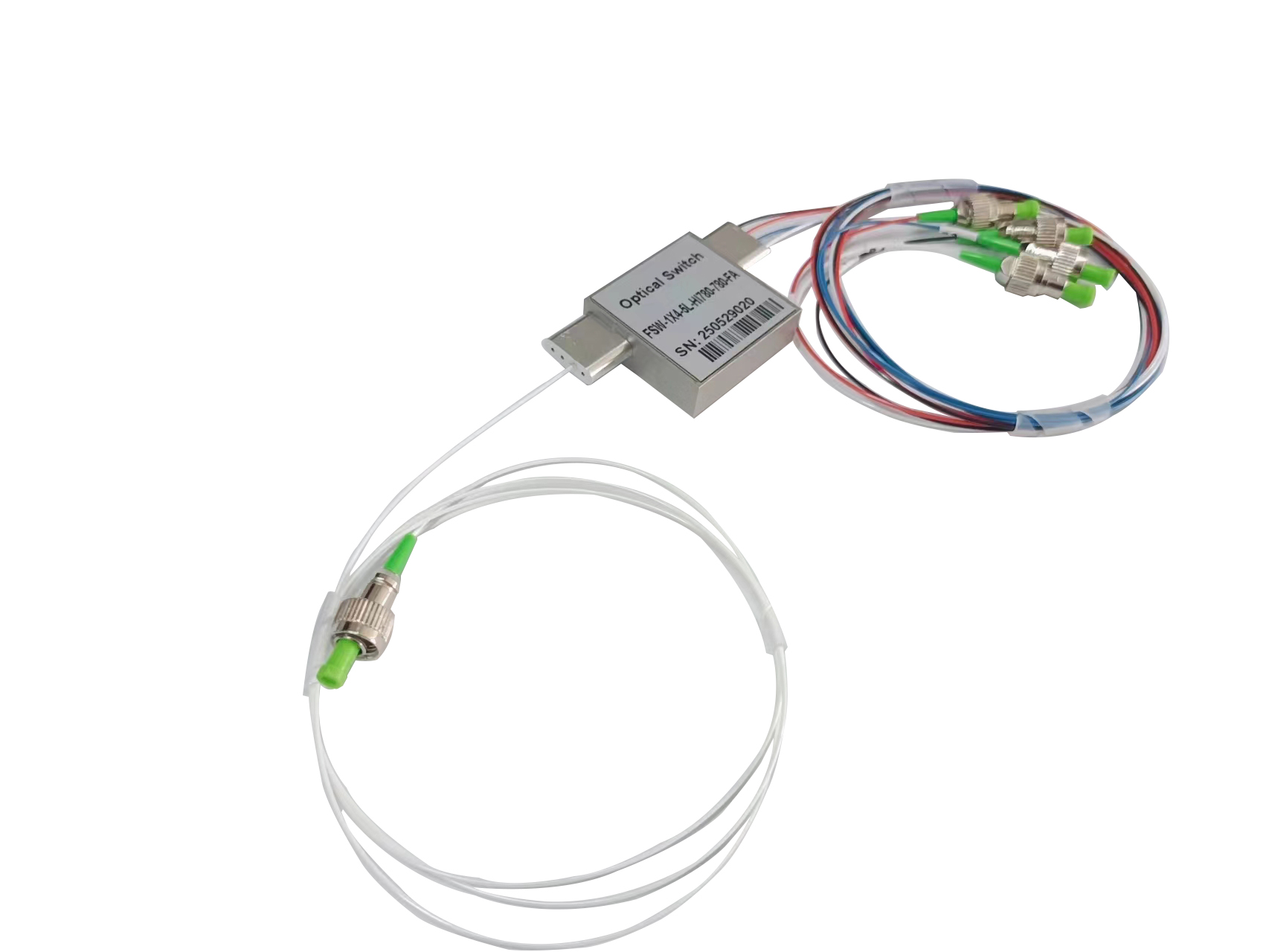
Detailed explanation and applications of the HI78nm 1×4 mechanical optical switch.
In the field of optical communication and optical testing, when application scenarios clearly require high reliability, low loss, operation at a specific wavelength (780nm band), and simple 1-to-4 routing functionality, the HI78nm 1X4 mechanical optical switch often becomes a trusted classic solution for engineers. This article will delve into the characteristics, principles, and applications of this device.
I. Overview
HI78nm: Clearly indicates that the device’s core operating wavelength is 780 nanometers. This is a very important near-infrared band, commonly found in:
Specific sensing systems (such as certain LiDAR and gas sensing).
Scientific research experiments (such as laser manipulation in atomic physics and cold atom experiments).
Industrial applications (such as certain material processing and precision measurement).
The “HI” prefix may represent “High Isolation” or a manufacturer-specific series model identifier, meaning that the device has excellent optical performance in the 780nm band and can effectively suppress crosstalk between channels.
1X4: Defines its port configuration. That is, 1 input port and 4 output ports. It can selectively switch the optical signal from the input fiber to any one of the four output fibers.
Mechanical: Reveals its working principle. It changes the optical path through a precise miniature mechanical mechanism (such as a moving prism, mirror, or direct fiber switching).
II. Core Working Principle and Characteristics
Working Principle:
The switch typically contains a movable optical element (such as a miniature mirror or lens group) and a precise stepper motor or electromagnetic drive mechanism. After receiving an external TTL or relay signal, the control circuit drives the mechanical device to accurately align the input optical path with the optical path of the selected output port.
Main Features:
- Wavelength Specificity: The optical components (such as anti-reflective coatings and mirror coatings) are optimized for the 780nm band, ensuring extremely low insertion loss (typically below 1.0 dB) and very high return loss at this wavelength.
- Excellent Isolation: This is its key advantage. When switching to a specific output port, the other three output ports receive very little signal from the input (isolation is typically >50 dB), effectively avoiding inter-channel crosstalk, which is crucial for multi-channel parallel systems or testing.
- High stability and reliability: The mechanical structure is mature, and its performance is extremely stable in a fixed position, unaffected by temperature, current fluctuations, etc., ensuring high long-term reliability.
Mature technology and controllable cost: Compared to MEMS or waveguide switches, its design and manufacturing process are mature, offering a cost advantage when the number of ports is small (e.g., 1×4, 1×8).
Disadvantages:
Slow switching speed: Typically in the range of 10 to 50 milliseconds, unsuitable for applications requiring nanosecond or microsecond-level fast switching.
Mechanical wear: Long-term frequent switching (e.g., millions of times or more) may lead to performance degradation.
Sensitive to vibration: Performance may be unstable in strong vibration environments.
III. Typical Application Scenarios
Due to its “specific wavelength + reliable routing” characteristics, the HI78nm 1×4 mechanical optical switch is widely used in the following fields:
- Multi-channel optical testing systems:
In 780nm laser or device production lines, it is used to automatically switch the test light source to multiple devices under test, enabling automated testing and improving efficiency.
In laboratories, it is used to build flexible optical paths, distributing a 780nm laser beam to different experimental platforms. - Sensing networks and monitoring systems:
In distributed sensing networks based on 780nm lasers (such as some fiber Bragg grating sensing demodulation systems), it acts as an optical path selector, sequentially querying multiple sensors. - Scientific research and experimental optical platforms:
In cutting-edge scientific research such as quantum optics and cold atom physics, 780nm is often the resonance wavelength of the rubidium atom D2 line. This switch can be used to switch cooling and detection optical paths between multiple vacuum chambers or experimental areas. - Optical network protection (specific band):
In dedicated industrial networks using the 780nm band for communication or control, it acts as a simple 1-main-3-backup line protection switch. When the main line fails, the signal is switched to the backup route.
IV. Selection and Usage Precautions
- Wavelength Matching: Ensure that the center wavelength of your system’s light source matches the optimized wavelength of this switch (780nm). Otherwise, insertion loss and isolation will significantly deteriorate.
- Switching Speed Requirements: Evaluate whether your application can tolerate millisecond-level switching times.
- Driving Method: Confirm that the control interface (e.g., TTL level, USB, RS-232) is compatible with your control system.
- Fiber Type: Confirm that the port connector type (e.g., FC/APC, SC/PC) and fiber type (e.g., SMF-28e) are consistent with your system.
- Operating Environment: Avoid using the switch in environments with frequent vibration or extreme temperatures to prevent affecting mechanical precision and lifespan.
V. Summary
The HI78nm 1X4 mechanical optical switch is a dedicated optical path routing device specifically designed for the 780nm wavelength band. With its low loss, high isolation, and excellent stability at the target wavelength, it occupies an irreplaceable position in applications that do not require ultra-high-speed switching but highly value reliable optical performance and signal purity. It is a robust and reliable “optical manual switch” for connecting precision light sources to multiple terminals.